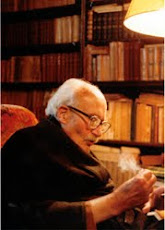
Note: This entry is designed to give the reader some idea of Gómez Dávila's "hierarchical axiology," the intersection of values and hierarchy. This philosophy is what lies behind most of his observations on other topics, and is essential to his entire work. Indeed, as he said in his essay "The Authentic Reactionary," the reactionary seeks out values in history; he is a "hunter of sacred shade upon the eternal hills." This entry focuses on the philosophical aspect of hierarchy; hierarchy as a principle of social order is addressed more fully in the entry on democracy and equality.
None of us finds it difficult to love the neighbor who seems inferior to us.
But to love someone we know is superior is another thing. (#677)
There is something definitively vile about the man who only admits equals, who does not tirelessly seek out his betters. (#2,655)
Loyalty to a doctrine ends in adherence to the interpretation we give it.
Only loyalty to a person frees us from all self-complacency. (#2,445)
Authentic superiority is intolerable for the fool.
Its simulacra, on the other hand, fascinate him. (#2,007)
He who accepts the rank which nature assigns him does not turn into the mere absence of what he is not.
Even the most modest thing has, in its proper place, immeasurable worth. (#324)
Every non-conformist knows, in the depths of his soul, that the place his vanity rejects is the exact same place his nature has assigned him. (#975)
To be a protagonist in the drama of life, it is enough to be a perfect actor, whatever the role one plays.
Life has no secondary roles, only secondary actors. (#416)
There is no contemptible occupation, as long as it is not credited with any importance it does not have. (#1,873)
Society tends to be unjust, but not in the way the conceited imagine.
There are always more masters who do not deserve their position than servants who do not deserve theirs. (#509)
In aristocratic times what has value is priceless; in democratic times what is priceless has no value. (#1,679)
If we do not have hierarchies, we are eventually unjust with everything.
Even with what we were, or what we are. (#1,224)
Duties or pleasures, objects or persons: it suffices to move them from the subordinate place corresponding to each one to turn them into nothing. (#974)
Pleasures abound as long as we do not confuse their ranks. (#2,517)
The reactionary is not upset by certain things, but by anything out of place. (#1,622)
The world becomes filled with contradictions when we forget that things have ranks. (#2,664)
The total truth will not be the indigestion of a dialectical process that swallows all the partial truths, but the limpid structure in which they are ordered. (#1,824)
The lower truths tend to eclipse the highest truths. (#2,785)
Truths do not contradict each other except when they fall out of order. (#2,575)
Authority is not delegating men, but procuring values. (#570)
Revelation is the value that suddenly supervenes on a psychological event. (#943)
Values, like the soul, are born in time, but do not belong to it. (#1,025)
Values, like souls for the Christian, are born in history but are immortal. (#1,264)
Values are not citizens of this world, but pilgrims from other heavens. (#1,037)
Everything that has value in the world is incongruous to it, and the world does not drag it along into the sunset.
Our past happinesses await us at the end of the day’s journey to anoint our injured feet. (#1,750)
All earthly splendor is the labor of astounded hands, because no splendor depends on the human will.
Because all splendor refutes the radical assertion of sin. (#1,910)
“Meaning,” “significance,” “importance,” are terms which do not merely designate transitive relations.
There are things with meaning, significance, importance, in themselves. (#2,841)
Everything rolls toward death, but only what lacks value rolls toward nothingness. (#1,938)
Man rarely understands that nothing is permanent, but that some things are immortal. (#2,473)
We should not be frightened: what we admire does not die.
Nor be delighted: neither does what we detest. (#2,056)
We who want to admit nothing but what has value, will always seem naïve to those who recognize nothing but what is in force. (#2,830)
History owes its importance to the values that emerge there, not to the masses of men who are shipwrecked there. (#1,481)
The sensual is the presence of a value in the sensible. (#250)
The history of art is the history of its materials, its techniques, its themes, its social conditions, its psychological motives, or its set of intellectual problems, but never the history of beauty.
A value has no history. (#606)
The perfection of a work of art depends on the degree of obedience of its diverse elements to their proper hierarchy. (#1,641)
We should only encourage someone to do something that is worth doing because it is worth it.
Goodness for goodness’s sake, truth for truth’s sake, art for art’s sake. (#2,607)
Nothing endures for certain and only instances count, but the instant reserves its splendor for someone who imagines it to be eternal.
The only thing that has value is the ephemeral which appears immortal. (#790)
It is not true that things have value because life matters. On the contrary, life matters because things have value. (#73)
The indemonstrability of values makes obvious opinions seem daring to one who does not see values. (#2,420)
When we make a value judgment let us never invoke authorities.
The value judgment testifies to itself. Every argument degrades it. (#2,126)
To live is modern man’s only value.
Even the modern hero does not die except in the name of life. (#350)
Elegance, dignity, nobility are the only values life does not succeed in disrespecting. (#133)
Discipline, order, hierarchy, are aesthetic values. (#2,483)
Good manners, in the end, are nothing but the way in which respect is expressed.
Since respect, in its turn, is a feeling inspired by the presence of an admitted superior, wherever hierarchies are absent—real or fictitious, but revered—good manners die out.
Rudeness is a democratic product. (#644)
Man’s different postures place him before different values.
There exists no privileged position from which to observe the conjunction of all values into one single value. (#1,730)
Not reject, but prefer. (#249)
He who knows how to prefer does not exclude.
He puts in order. (#2,510)
Relativism is the solution of one who is incapable of putting things in order. (#2,103)
When one is confronted by diverse “cultures,” there are two symmetrically erroneous attitudes: to admit only one cultural standard, and to grant all standards the same rank.
Neither the overweening imperialism of the European historian of yesterday, nor the shameful relativism of the European historian of today. (#2,673)
It is not to resolve contradictions, but to order them, to which we can aspire. (#1,836)
Leveling is the barbarian’s substitute for order. (#215)
Hierarchies are heavenly.
In Hell all are equal. (#1,451)
In society just as in the soul, when hierarchies abdicate the appetites rule. (#1,719)
Man emerges from the beast when he orders his instincts hierarchically. (#1,917)
The authentic individual cannot be added up; he can only be placed in order. (#1,978)
Only by establishing hierarchies can we limit the imperialism of the idea and the absolutism of power. (#1,490)
Absolutism, whether intellectual or political, is the capital sin against the hierarchical method.
Usurpation, by one of the terms in the system, of the liberties of the others. (#1,701)
The absolutist wishes for a sovereign force that will subdue all others, the liberal a multitude of weak forces that will neutralize each other.
But the axiological commandment decrees hierarchies of multiple vigorous and active forces. (#1,925)
Showing posts sorted by relevance for query order. Sort by date Show all posts
Showing posts sorted by relevance for query order. Sort by date Show all posts
January 8, 2010

The Bourgeoisie & Capitalism
Note: This entry is designed to gather into one place the aphorisms in which Gómez Dávila mentions the bourgeoisie, capitalism, and industry.
The Gospels and the Communist Manifesto are on the wane; the world’s future lies in the power of Coca-Cola and pornography. (#2,983)
The bourgeois gives up his power in order to save his money; then he gives up his money in order to save his skin; and finally they hang him. (#22)
The bourgeois does not applaud the man he admires, but the man he fears. (#1,502)
Bourgeois reformers prepare legal precedents for their future despoilers. (#1,105)
The bourgeoisie is any group of individuals dissatisfied with what they have and satisfied with what they are. (#23)
The bourgeoisie, despite everything, has been the only social class capable of judging itself.
Every critic of the bourgeoisie feeds off of bourgeois criticisms. (#515)
Whoever denies the bourgeoisie its virtues has been infected with the worst of its vices. (#1,923)
Modern history, ultimately, comes down to the defeat of the bourgeoisie and the victory of bourgeois ideas. (#981)
The left’s bourgeois mentality will successively reconstruct all bourgeois societies that the left successively destroys. (#1,683)
Marxists define the bourgeoisie in economic terms in order to hide from us the fact that they belong to it. (#24)
The leftist obviously refuses to understand that the conclusions of bourgeois thought are the principles of leftist thought. (#2,231)
A man is called a Communist if he fights for the state to assure him a bourgeois existence. (#1,372)
A class-conscious proletariat, in Marxist vocabulary, means a people that has converted to bourgeois ideals. (#2,691)
Identifying the bourgeois class with the bourgeois mentality tricks the enemies of the bourgeoisie.
The liquidation of a bourgeois class in the modern world is, in effect, nothing more than a slaughter that does not imply the abolition of a bourgeois mentality that already dominates all of society. (#2,216)
The proletarian does not detest the bourgeoisie for any reason other than the economic difficulty of imitating it. (#379)
Socialism arose as nostalgia for the social unity destroyed by bourgeois atomism.
But it did not understand that social unity is not the totalitarian condensing of individuals, but the systematic totality of a hierarchy. (#1,965)
The bourgeoisie, in the feudal framework, settles in small urban centers where it becomes structured and civilized.
With the break-up of this framework, the bourgeoisie spreads across all of society, invents the nationalist state, rationalist technology, anonymous urban agglomerations, industrial society, the mass man, and finally the process in which society wavers between the despotism of the mob and the despotism of the expert. (#2,181)
The modern world resulted from the confluence of three independent causal series: the demographic expansion, democratic propaganda, the industrial revolution. (#2,960)
The proletariat appears when the people become a class which adopts bourgeois values without possessing bourgeois property. (#577)
The proletariat gravitates to the bourgeois life, just as bodies gravitate to the center of the earth. (#1,060)
It never occurs to the intellectual who is indignant at the “embourgeoisement of the proletariat” to renounce those things whose enjoyment by the proletariat horrifies him as proof of embourgeoisement. (#1,346)
The embourgeoisement of the proletariat originated in its conversion to the industrial gospel preached by socialism. (#1,830)
The embourgeoisement of Communist societies is, ironically, modern man’s last hope. (#2,809)
In modern society, capitalism is the only barrier to the spontaneous totalitarianism of the industrial system. (#2,946)
The supposed enemies of the bourgeoisie are expert gardeners who prune its caducous branches.
Bourgeois society is not in danger as long as its enemies admire what it admires. (#1,680)
The state has not behaved with discretion and restraint except when it has been watched by rich bourgeoisies. (#2,784)
With the whole world becoming more bourgeois, I miss the dead aristocracy less than I miss the vanished people. (#849)
“A classless society” is one where there is neither aristocracy nor people.
Where only the bourgeois moves around freely. (#1,699)
With the disappearance of the upper class, there is nowhere to take refuge from the smugness of the middle class and the rudeness of the lower class. (#1,934)
For more than a century there has been no upper class.
Barely even a more pretentious segment of the middle class. (#2,195)
The reactionary does not condemn the bourgeois mentality, but rather its predominance.
What we reactionaries deplore is the absorption of the aristocracy and the people by the bourgeoisie.
It is the emasculation of liberty or, alternatively, of equality. (#1,609)
Marxism will only rest when it has transformed peasants and workers into petty-bourgeois office clerks. (#447)
Revolution—every revolution, revolution per se—is the matrix of bourgeoisies. (#899)
It is not so much the plebeian merriment that revolutions unleash which frightens the reactionary as the zealously bourgeois order that they produce. (#1,826)
A youth’s revolutionary activity is the rite of passage between adolescence and the bourgeoisie. (#1,795)
The militant communist before his victory deserves the greatest respect. Afterwards, he is nothing more than an overworked bourgeois. (#25)
In medieval society, society is the state; in the bourgeois society, state and society confront each other; in the Communist society, the state is society. (#62)
Vulgarity consists in striving to be what we are not. (#67)
Vulgarity is not a product of the people but a subproduct of bourgeois prosperity. (#1,539)
“Être absolumente moderne” is the characteristic desire of the petit bourgeois. (#1,805)
Compared to so many dull intellectuals, to so many artists without talent, to so many stereotyped revolutionaries, a bourgeois without pretensions looks like a Greek statue. (#871)
A peaceful bourgeois existence is the authentic longing of the human heart. (#1,058)
Criticism of the bourgeois receives praise from two sources: from the Marxist, who considers us intelligent because we confirm his prejudices; and from the bourgeois, who considers us wise because he is thinking about his neighbor. (#167)
Adherence to Communism is the rite which allows the bourgeois intellectual to exorcise his uneasy conscience without abjuring his bourgeois identity. (#310)
Nothing softens up the bourgeois more than a revolutionary from a foreign country. (#1,290)
Apostatizing from literature is how one makes a career today in letters, like apostatizing from the bourgeoisie among the bourgeois. (#546)
Yesterday’s bourgeois forgave himself everything, if his sexual conduct was strict.
Today’s forgives himself everything, if it is promiscuous. (#1,320)
The results of modern “liberation” make us remember with nostalgia the abolished “bourgeois hypocrisies.” (#2,870)
Those who insist on being up to date with today’s fashion are less irritating than those who try too hard when they do not feel that they are up to date with tomorrow’s fashion.
The bourgeoisie is aesthetically more tolerable than the avant-garde. (#2,955)
If the philosophy and the arts and letters of the past century are only the superstructures of its bourgeois economy, we should defend capitalism to the death.
All stupidity commits suicide. (#222)
If yesterday’s bourgeois bought pictures because their subject was sentimental or picturesque, today’s bourgeois does not buy them when they have a picturesque or sentimental subject.
The subject continues to sell the picture. (#985)
It is possible to inculcate in the contemporary bourgeois any stupid idea in the name of progress and to sell him any grotesque object in the name of art. (#1,520)
“Psychology” is, properly speaking, the study of bourgeois behavior. (#288)
In a bourgeois country, just as in a Communist land, they disapprove of “escapism” as a solitary vice, as a debilitating and wretched perversion.
Modern society discredits the fugitive so that no one will listen to his account of his journeys. Art or history, man’s imagination or his tragic and noble destiny, these are not criteria which modern mediocrity will tolerate.
“Escapism” is the fleeting vision of abolished splendors and the probability of an implacable verdict on today’s society. (#305)
The communist hates capitalism with the Oedipus complex.
The reactionary views it only with xenophobia. (#316)
Leftists and rightists merely argue about who is to have possession of industrial society.
The reactionary longs for its death. (#2,179)
Mechanization is stultifying because it makes man believe that he lives in an intelligible universe. (#2,700)
Modern architecture knows how to erect industrial shacks, but it does not succeed in building either a palace or a temple.
This century will leave behind only the tire-tracks of the transports it employed in the service of our most sordid greed. (#388)
It never again mattered to me where I lived after I saw the spacious, dilapidated homes pass away and the wide open, deserted fields of my infancy covered with industrial and human filth. (#2,366)
I do not yearn for a virgin nature, a nature without the peasant’s ennobling footprint and without the palace crowning the hill.
But a nature safe from plebeian industrialism and irreverent manipulation. (#989)
Idle wealth is wealth which only serves to produce more wealth. (#466)
The rich man, in capitalist society, does not know how to put money to its best use: so that he does not have to think about it. (#2,356)
After seeing work exploit and demolish the world, laziness seems like the mother of the virtues. (#2,053)
Artificially fomenting greed, in order to become rich by satisfying it, is the unforgiveable sin of capitalism. (#1,370)
It turns out it is impossible to convince a businessman that a profitable activity can be immoral. (#2,426)
Modern optimism is a commercial product designed to oil the wheels of industry. (#1,423)
The modern mentality is the child of human pride puffed up by commercial advertising. (#2,688)
The three stages of capitalism: in the first, the businessman trades in order to construct palaces for himself; in the second, to reinvest his earnings; in the third, to pay taxes. (#1,181)
The businessman’s greed surprises me less than the seriousness with which he satisfies it. (#561)
The upper class in society is the class for which economic activity is a means, the middle class that for which it is an end.
The bourgeois does not aspire to be rich, but to be richer. (#622)
An aristocratic society is one where the desire for personal perfection is the animating spirit of the social institutions. (#656)
Art is the most dangerous reactionary ferment in a democratic, industrial, and progressive society. (#1,138)
Capitalism is the monstrous distortion of private property by liberal democracy. (#2,334)
Liberty’s remaining partisans in our time tend to forget that a certain old and trivial bourgeois thesis is the proof itself: the condition sine qua non of liberty, for the proletariat as well as for the owners, is the existence of private property.
Direct defense of liberty for the ones; indirect defense of liberty for the others. (#2,837)
The “ownership mentality,” so sharply censured by modern man, has transformed into a usufruct mentality that avidly exploits persons, works, things, without reserve, without pity, without shame. (#2,463)
If one only aspires to provide a growing number of persons with a growing number of goods, without worrying about the quality of the persons, or of the goods, then capitalism is the perfect solution. (#2,002)
Consumption, for the progressive, is justified only as a means of production. (#399)
Instead of “industrial society,” it is in fashion to say “consumer society” in order to avoid the problem by pretending to confront it. (#1,557)
Industrial society is condemned to forced perpetual progress. (#257)
Capitalism is the vulgar side of the modern soul, socialism its tedious side. (#1,855)
Capitalism is abominable because it achieves that disgusting prosperity promised in vain by the socialism that hates it. (#942)
Socialism makes use of greed and misery; capitalism makes use of greed and the vices. (#2,433)
Capitalist society became wealthy by joining the ignorance of an astute entrepreneur, whose job is to direct, with the science of a stupid technician, whose job is to execute.
Socialism seeks to become wealthy by entrusting the task of directing to the technician. (#1,103)
An economy is called socialist if it needs to make great efforts to set up the spontaneous mechanisms of capitalism. (#844)
Socialism is the commercial name of state capitalism on the electoral market. (#1,642)
Industrial society is the expression and fruit of souls in which virtues destined to serve usurp the place of virtues destined to command. (#480)
The universe takes revenge on those who treat it as an inanimate mechanism not by making them die humiliated, but rather prosperous and brutish. (#995)
In order to cure the patient it injured in the 19th century, industrial society had to numb his mind in the 20th century.
Spiritual misery is the price of industrial prosperity. (#1,636)
The modern mentality’s conceptual pollution of the world is more serious than contemporary industry’s pollution of the environment. (#2,336)
In order to make the technician devote all his attention to his job, industrial society, without disfiguring his skull, compresses his brain. (#1,758)
A prolonged childhood—permitted by industrial society’s current prosperity—redounds merely in a growing number of infantilized adults. (#2,453)
God invented tools, the devil machines. (#1,315)
The man who invents a new machine invents for humanity a new concatenation of new forms of servitude. (#2,340)
The great industrial trade fairs are the showcase of everything civilization does not require. (#2,328)
The wealth of a merchant, of an industrialist, of a financier, is aesthetically inferior to wealth in land and flocks. (#2,824)
Civilization is in agony when agriculture forsakes being a way of life in order to become an industry. (#1,211)
The industrialization of agriculture is stopping up the source of decency in the world. (#2,912)
Totalitarian society is the common name for the social species whose scientific name is industrial society.
The embryo today allows us to foresee the adult animal’s deformity. (#481)
The standard-bearers of liberty celebrated by the 19th century ended up as the vanguard of industrial despotism. (#1,319)
The ease with which industrial capitalism constructs and destroys—obeying clear precepts of profitability—transforms the average man into an intellectual, moral, and physical nomad.
Whatever is permanent today is an obstacle. (#2,194)
The ruling class of an agrarian society is an aristocracy, that of an industrial society an oligarchy. (#1,519)
The reactionary’s ideal is not a paradisiacal society. It is a society similar to the society that existed in the peaceful intervals of the old European society, of Alteuropa, before the demographic, industrial, and democratic catastrophe. (#2,947)
To industrialize a country, it is not enough to expropriate the rich man; it is necessary to exploit the poor man. (#485)
Under the pretext of giving work to the hungry, the progressive sells the useless artifacts he produces.
The poor are industrialism’s pretext for enriching the rich man. (#486)
It would be easier to resolve modern problems, if, for example, it were possible to sustain the Utopian fancy that what causes the multiplication of plastic objects is only the manufacturer’s commercial greed, and not the idiotic admiration of the presumed buyers. (#847)
For the myth of a past golden age, present day humanity today has substituted the myth of a future plastic age. (#952)
When the business acumen of some exploits the cultural sanctimoniousness of others, one says that culture is spreading. (#2,080)
The cultural rickets of our time is a result of the industrialization of culture. (#2,304)
The leftist Catholic is correct in discovering in the bourgeois the rich man of the parable, but is mistaken in identifying the militant proletariat with the poor of the Gospel. (#717)
Indignant with the bourgeois who “eases his conscience” by giving alms from his own private wealth, the leftist Catholic proposes to do it through self-sacrifice by distributing the private wealth of others. (#858)
Bourgeois hegemony culminates with the industrialization of Communist society.
The bourgeoisie is not so much a social class as the ethos of industrial society itself. (#494)
The leftist is so worried about the problems of the 19th century that he does not worry about the problems of the 20th century.
The problems raised by the industrialization of society prevent him from seeing the problems raised by industrialized society. (#600)
Three persons in our age make it their profession to detest the bourgeoisie:
the intellectual—that typical representative of the bourgeoisie;
the communist—that faithful executor of bourgeois intentions and ideals;
the progressive cleric—that final triumph of the bourgeois mind over the Christian soul. (#706)
The progressive cleric excoriates the “ghetto mentality” of the old Christian today.
Those clerics prefer the commercial and financial activity of the modern Jew to the ghetto where Israel’s faithfulness flourished. (#682)
In order to ally himself with the Communist, the leftist Catholic asserts that Marxism merely criticizes Christianity’s compromises with the bourgeoisie, when it is Christianity’s essence which Marxism condemns. (#699)
Revolutions & Revolutionaries
Note: This entry is designed to gather into one place the aphorisms in which Gómez Dávila mentions revolutions and revolutionaries. Other aphorisms relevant to the topic of revolutions and revolutionaries might be found under the heading of Marx & Marxists and Progress & Progressives.
Useless, like a revolution. (#1,024)
Revolution is progressivist and seeks the strengthening of the state; rebellion is reactionary and seeks its disappearance.
The revolutionary is a potential government official; the rebel is a reactionary in action. (#1,439)
Victorious revolutions have been outbursts of greed. Only defeated revolutions tend to be insurrections of the oppressed. (#2,135)
The war in the Vendée is the only political conflict that arouses my complete sympathy without troubling my reason. (Bastille Day)
After every revolution the revolutionary teaches that the true revolution will be tomorrow’s revolution.
The revolutionary explains that a despicable villain betrayed yesterday’s revolution. (#20)
The militant communist before his victory deserves the greatest respect.
Afterwards, he is nothing more than an overworked bourgeois. (#25)
The revolutionary attitude of modern youth is unequivocal proof of their aptitude for a career in administration.
Revolutions are perfect incubators of bureaucrats. (#782)
A youth’s revolutionary activity is the rite of passage between adolescence and the bourgeoisie. (#1,795)
A bureaucratic destiny awaits revolutionaries, like the sea awaits rivers. (#1,228)
Bureaucracies do not succeed revolutions by coincidence.
Revolutions are the bloody births of bureaucracies. (#971)
It is not so much the plebeian merriment that revolutions unleash which frightens the reactionary as the zealously bourgeois order that they produce. (#1,826)
The revolutionary’s picturesque outfit changes colors imperceptibly until it matches the severe uniform of a police officer. (#1,827)
Revolution—every revolution, revolution per se—is the matrix of bourgeoisies. (#899)
Revolutions do not solve any problem other than the economic problem of their leaders. (#1,525)
Revolutions are carried out in order to change the ownership of property and the names of streets.
The revolutionary who seeks to change “man’s condition” ends up being shot for being a counter-revolutionary. (#2,523)
They speak emphatically of “transforming the world,” when the most to which they can aspire is to certain secondary remodelings of society. (#2,797)
Revolutionary opinions are the only career, in contemporary society, which assures a respectable, lucrative, and peaceful social position. (#730)
Nothing softens up the bourgeois more than a revolutionary from a foreign country. (#1,290)
Today’s revolutionaries are just impatient heirs.
Revolution will be spoken of seriously when the “consumption” they hate is not just someone else’s consumption. (#919)
Every revolution makes us nostalgic for the previous one. (#406)
The struggle against injustice that does not culminate in sanctity culminates in bloody upheavals. (#54)
Every rebellion against the order of man is noble, so long as it does not disguise rebelliousness against the order of the world. (#528)
An historical period is the period of time during which a certain definition of the legitimate prevails.
Revolution is the transition from one definition to another. (#901)
No one rebels against authority, but only against those who usurp it. (#726)
The first revolution broke out when it occurred to some fool that law could be invented. (#900)
Virtue that does not doubt itself culminates in attacks against the world. (#308)
Every individual with “ideals” is a potential murderer. (#618)
A simple fit of impatience often soon bridges the distance between utopia and murder. (#2,713)
The shamelessness with which the revolutionary kills is more frightening than his killings. (#1,504)
Power corrupts no one without fail except the revolutionary who assumes it. (#1,542)
The individual today rebels against immutable human nature so that he might refrain from amending his own correctable nature. (#210)
Popular disturbances lack importance so long as they do not become ethical problems for the ruling classes. (#146)
Concessions are the steps up the gallows. (#1,067)
Reforms are the entrance ramps to revolutions. (#1,993)
When economic and social revolutions are not simply ideological pretexts for religious crises, after a few years of disorder everything continues as before. (#1,018)
Whoever inquires into the causes of a revolution should never infer them from its effects.
Between the causes of a revolution and its effects are whirlwinds of accidents. (#1,291)
Revolution is a permanent historical possibility.
Revolution does not have causes, but occasions it takes advantage of. (#2,221)
True revolutions do not begin with their public outbreak, but rather end with it. (#1,019)
Every episode of a revolution needs a partisan to relate it and an adversary to explain it. (#2,058)
Those who defend revolutions cite speeches; those who accuse them cite facts. (#2,749)
When individual envies come together, we customarily christen them “noble popular aspirations.” (#364)
The atrocity of the act of revenge is proportional not to the atrocity of the offense, but to the atrocity of the man taking revenge.
(For the methodology of revolutions.) (#225)
Stupidity is the mother of revolutionary atrocities.
Savageness is only the godmother. (#1,298)
The revolutionary is, basically, a man who does not suspect that humanity can commit a crime against itself. (#762)
Revolutions are more a subject for sociology than for history.
Manifestations of those depths of human nature that nothing educates, nothing civilizes, nothing ennobles, revolutions despoil man of his history and return him to bestial behaviors. (#2,243)
“Liquidating” a social class, or a people, is an undertaking that angers no one in this century but the intended victims. (#254)
Tyrannies have no more faithful servants than revolutionaries who are not protected against their inborn servility by witnessing a firing squad at a young age. (#281)
The revolutionary does not discover the “authentic spirit of the revolution” except before the revolutionary tribunal that condemns him. (#1,665)
Youths are not necessarily revolutionary but rather necessarily dogmatic. (#1,534)
Revolutionary intellectuals have the historic mission of inventing the vocabulary and the themes for the next tyranny. (#443)
Every revolution exacerbates the evils against which it breaks out. (#1,243)
Will the revolutionary learn some day that revolutions prune rather than uproot? (#1,401)
Democratic revolutions begin the executions as they announce the prompt abolition of the death penalty. (#315)
The fervor with which the Marxist invokes the future society would be moving if the rites of invocation were less bloody. (#1,430)
The leftist screams that freedom is dying when his victims refuse to finance their own murders. (#375)
Man pays for the intoxication of liberation with the tedium of liberty. (#396)
What most likely is upon us is not a revolutionary terror, but a counter-revolutionary terror implemented by disgusted revolutionaries. (#1,077)
To be a revolutionary one must be a little daft; to be a conservative, a little cynical. (#1,027)
Stupidity is the fuel of revolutions. (#1,252)
Even though history does not have laws, the course of a revolution is easily foreseen, because stupidity and madness do have laws. (#2,222)
Between the causes of a revolution and its realization in actions ideologies insert themselves which end up determining the course and even the nature of events.
“Ideas” do not “cause” revolutions, but channel them. (#2,748)
Revolutions have as their function the destruction of the illusions that cause them. (#1,621)
For the true results of a prior revolution, let us consult the revolutionaries who are preparing the next one. (#2,008)
The authentic revolutionary rebels in order to abolish the society he hates; today’s revolutionary revolts in order to inherit one he covets. (#407)
Revolutionaries do not destroy anything, in the end, except what made the societies against which they rebel tolerable. (#1,046)
Even when it is right, a revolution solves nothing. (#1,618)
Revolutions are not the locomotives but the derailments of history. (#1,171)
Revolutions destroy nothing of nations except their souls. (#1,207)
Revolutions bequeath to literature only the laments of their victims and the invectives of their enemies. (#1,658)
The lie is the muse of revolutions: it inspires their programs, their proclamations, their panegyrics.
But it forgets to gag their witnesses. (#1,666)
Great democratic upheavals do incurable harm to the soul of a people. (#1,419)
A civilization’s memory resides in the continuity of its institutions.
The revolution that interrupts a civilization's memory, by destroying those institutions, does not relieve society of a bothersome caparison that is paralyzing it, but merely forces it to start over. (#1,130)
Revolutionary agitation is an endemic in the cities and only an epidemic in the country. (#1,479)
Repentant, like a victorious revolutionary. (#1,034)
The left’s ideas produce revolutions; revolutions produce the right’s ideas. (#1,515)
Reactionaries are recruited from among the front-row spectators of a revolution. (#1,325)
The most convinced reactionary is the repentant revolutionary, that is to say: the man who has known the reality of the problems and has discovered the falseness of the solutions. (#2,163)
The reactionary is the guardian of every heritage.
Even the heritage of the revolutionary. (#1,623)
Compared to so many dull intellectuals, to so many artists without talent, to so many stereotyped revolutionaries, a bourgeois without pretensions looks like a Greek statue. (#871)
A “revolutionary” today means an individual for whom modern vulgarity is not triumphing quickly enough. (#2,807)
Neither a revolutionary's eloquence, nor love letters, can be read by third parties without laughing. (#1,238)
A motto for the young leftist: revolution and pussy. (#1,083)
Revolution already seems to be less a tactic for executing a plan than a drug for fleeing from modern boredom during one’s spare time. (#1,897)
When a revolution breaks out, the appetites are placed at the service of ideals; when the revolution triumphs, ideals are placed at the service of the appetites. (#2,747)
Revolutions swing back and forth between puritanism and debauchery, without touching civilized ground. (#1,383)
The looks of the participants in candid photographs of revolutionary scenes seem half cretinous, half demented. (#1,678)
Latin American revolutions have never sought anything more than to hand power over to some Directoire. (#830)
Revolutions are frightening, but election campaigns are disgusting. (#1,444)
The progressive clergyman, in revolutionary periods, ends up dead, but not as a martyr. (#1,251)
Absolute revolution is the favorite topic of those who do not even dare to protest when they are trodden on. (#1,614)
Arts & Letters
Note: This entry is designed to gather into one place the aphorisms in which Gómez Dávila mentions art and literature, as well as aesthetics and architecture.
Time distills the truth in the still of art. (#1,863)
Reading is an unsurpassable drug, because more than just the mediocrity of our lives, it allows us to escape the mediocrity of our souls. (#1,667)
The collision with an intelligent book makes us see a thousand stars. (#2,300)
A book does not educate someone who reads it to become educated. (#69)
True reading is an escape.
The other type is an occupation. (#2,506)
The books from which we would not like to part tend to be those which we refused to approach. (#1,958)
To teach literature is to teach the pupil to believe that he admires what he does not admire. (#2,047)
The true reader clings to the text he reads like a shipwrecked man to a floating plank. (#2,073)
The pleasant book does not attract the fool unless a pedantic interpretation vouches for it. (#1,820)
The palate is the only suitable laboratory for the analysis of texts. (#1,955)
The perfect transparency of a text is, with nothing more, a sufficient delight. (#2,736)
Contemporary man admires only hysterical texts. (#2,630)
Literature is not a psychological drug, but a complex means of communication for saying complex things.
A melodramatic or cacophonous text, besides being ugly, is false. (#1,959)
Admiring only mediocre works, or reading only masterpieces, characterize the uncultivated reader. (#1,909)
The most dangerous illiteracy is not that of a man who disrespects all books, but that of a man who respects them all. (#2,245)
A good book from yesterday does not seem bad except to the ignoramus; on the other hand, a mediocre book from today can seem good even to a cultivated man. (#2,620)
The “common reader” is as rare as common sense. (#2,524)
An extensive card catalog, an imposing library, a serious university, produce today those avalanches of books that contain not one error nor one insight. (#2,421)
The book that does not scandalize the expert a little has no reason to exist. (#2,645)
Serious books do not instruct, but rather demand explanations. (#506)
The impact of a text is proportional to the cunning of its insinuations. (#1,165)
Only he who suggests more than what he expresses can be reread. (#2,771)
Each new truth we learn teaches us to read a different way. (#514)
How to read is the last thing one learns. (#1,770)
A single paragraph of sense is enough for us to have to attribute the text’s incoherence to our ineptness. (#2,296)
In unremarkable texts we soon trip on phrases that penetrate into us, as if a sword has been thrust into us up to the hilt. (#2,834)
To understand a text, one must walk around it slowly, since no one gets in except through invisible posterns. (#2,096)
In authentic humanism there breathes the presence of a discreet and comfortable sensuality. (#75)
Art is the supreme sensual pleasure. (#1,321)
The spirit searches in a painting for a sensual enrichment. (#87)
We should politely welcome into our souls all of the world’s beauty.
Without delivering our eternal heart up to that transient guest. (#958)
Only goodness and beauty do not require limits.
Nothing is too beautiful or too good. (#2,544)
Goodness and beauty are not mutually exclusive except where goodness serves as a pretext for envy and beauty for luxury. (#2,450)
Every work of art speaks to us of God.
No matter what it says. (#1,089)
Goya is the seer of demons, Picasso their accomplice. (#1,580)
The titanism of modern art begins with the heroic titanism of Michelangelo and concludes with the cartoonish titanism of Picasso. (#2,028)
Art educates no one but the artist. (#651)
The civilizing effect of works of art is due less to the aesthetic value than to the ethic of aesthetic work. (#2,542)
The artist does not compete with his fellow artists; he does battle with his angel. (#1,819)
Civilizations enter into agony when they forget that there exists not merely an aesthetic activity, but also an aesthetic of activity. (#2,449)
The prestige of “culture” makes the fool eat though he is not hungry. (#92)
Arts and letters soon become sterile where the practice of them gives one wealth and the admiration of them prestige. (#2,541)
We should only encourage someone to do something that is worth doing because it is worth it.
Goodness for goodness’s sake, truth for truth’s sake, art for art’s sake. (#2,607)
Whoever does not move among works of art as if among dangerous animals does not know among what he moves. (#2,032)
Indifference to art is betrayed by the pompous solemnity of the homage often rendered it.
True love remains silent or mocks. (#592)
The two most insufferable types of rhetoric are religious rhetoric and the rhetoric of art criticism. (#2,572)
A good painting cuts short the art critic’s lyricism. (#2,109)
The greatest disrespect that can be paid to a work of art is to treat it as an expensive object.
No nouveau riche, fortunately, can hang a poem on the walls of his home. (#2,113)
In literature laughter dies quickly, but the smile is immortal. (#1,267)
In order to be able to speak disdainfully of the great writer who has passed out of fashion, the intellectual refrains from reading him. (#2,240)
How rare are those who do not admire books they have not read! (#553)
An illustrious author is not someone whom many people read, but someone whom many people believe they have read. (#1,205)
The readers of an illustrious author can be divided into two groups: those who admire him without reading him and those who disdain him without having read him. (#1,242)
All literature is contemporary for the reader who knows how to read. (#110)
When one century’s writers can write nothing but boring things, we readers change century. (#1,389)
The only 18th-century writer to be revived by the admiration of our contemporaries is de Sade.
Visitors to a palace who admire nothing but the latrines. (#812)
The sciences, particularly the social sciences, are depositing successive strata of barbarisms on top of literature. (#2,101)
Contemporary literature, in any period, is the worst enemy of culture.
The reader’s limited time is wasted by reading a thousand mediocre books that blunt his critical sense and impair his literary sensibility. (#512)
Prolixity is not an excess of words but a dearth of ideas. (#111)
Literature does not die because nobody writes, but when everybody writes. (#1,256)
Sub-literature is the group of worthy books that each new generation reads with pleasure, but which nobody can re-read. (#1,145)
Whereas contemporaries read only the optimist with enthusiasm, posterity rereads the pessimist with admiration. (#2,894)
The abundance of translations has taken away from translation its function as a selective gesture.
Translation used to be posterity’s advance; today it is the publisher’s business. (#2,185)
A truthful, upright intellectual life grabs out of our hands arts, letters, sciences, in order to prepare us to confront fate alone. (#134)
Art never grows tiresome because each work is an adventure which no previous success guarantees. (#141)
The perfection of a work of art depends on the degree of obedience of its diverse elements to their proper hierarchy. (#1,641)
Discipline, order, hierarchy, are aesthetic values. (#2,483)
The object is not constituted by the sum of its possible representations, but by the sum of its aesthetically satisfactory representations. (#1,849)
The definition locates the object, but only the description captures it. (#1,755)
Aesthetics indicates to the artist in which region of the universe the beauty for which he is searching can be found, but it does not guarantee him that he will succeed in capturing it. (#469)
The grandiloquence of theories of aesthetics increases with the mediocrity of the works, like that of orators with the decadence of their country. (#752)
The most disastrous folly in letters is observance of the aesthetic rule of the day. (#1,947)
The aesthetic impossibilities of an age stem not from social factors, but from internal censors. (#2,576)
Discipline is not so much a social necessity as an aesthetic obligation. (#477)
Aesthetic pleasure is the supreme criterion for well-born souls. (#1,853)
In aesthetics as well, one only reaches heaven by the uneven road and through the narrow gate. (#2,537)
Ethics should be the aesthetics of conduct. (#986)
Ethical conduct is the aesthetically satisfactory conduct. (#2,406)
Ethics and aesthetics, when divorced, each submit more readily to man’s whims. (#2,526)
Sin ceases to seem like a fiction when we have been slapped in the face by its aesthetic vulgarity. (#1,772)
The ugliness of the modern face is an ethical phenomenon. (#1,877)
If we are ignorant of an epoch’s art, its history is a colorless narrative. (#2,952)
The novel adds to history its third dimension. (#147)
The passage from one book to another book is made through life. (#179)
Words do not communicate, they remind. (#180)
Books are not tools of perfection but barricades against boredom. (#190)
Many a modern poem is obscure, not like a subtle text, but like a personal letter. (#195)
What is personal in the artist is not the person, but his vision of the world. (#834)
A writer’s biographers tend to eliminate the person in order to occupy themselves with his insignificant life. (#968)
The biographer should not confuse his obligation to tell us the how of his subject with the ridiculous pretension of explaining to us the why. (#1,765)
Interesting autobiographies would be plentiful if writing the truth were not an aesthetic problem. (#2,683)
We call the beauty of a language the skill with which some write it. (#1,395)
Classical Castilian means, with a few exceptions, an unreadable book. (#2,640)
Literary skill consists in keeping a phrase at the right temperature. (#1,885)
Precision in philosophy is a false elegance.
On the other hand, literary precision is the foundation of aesthetic achievement. (#1,918)
Poetry which disdains poetic musicality becomes petrified in a graveyard of images. (#336)
The pleasure of guessing the ingenious meaning of a metaphor tries to replace, in modern “poetry,” the mysterious joy of song. (#2,814)
In order to act, an operational notion of the object is required; but a poetic notion is required in order to understand. (#1,706)
To be stupid is to believe that it is possible to take a photograph of the place about which a poet sang. (#1,926)
The past is the source of poetry; the future is the arsenal of rhetoric. (#1,487)
Poetry must slip into this gloomy dusk like a partridge into the brush. (#1,675)
Oneiric poetry does not prophesy; it snores. (#1,476)
I appreciate the pedestrian gait of certain poetry, but I prefer the hard rhythm of where song is raised. (#2,543)
Lyric poetry alone survives, because the human heart is the only corner of the world which reason dares not invade. (#563)
What the beauty of a poem signifies has no connection at all with what the poem signifies. (#1,634)
Poetry is God’s fingerprint in human clay. (#870)
Poetry rescues things by reconciling matter and spirit in the metaphor. (#2,337)
Love uses the vocabulary of sex to write a text unintelligible to sex alone. (#2,686)
Man does not admire anything sincerely except what is undeserved.
Talent, lineage, beauty. (#1,552)
The laws of biology alone do not have fingers delicate enough to fashion the beauty of a face. (#1,317)
There are people who admit, without shame, that they “study” literature. (#630)
An authentic reader is someone who reads for pleasure the books which everyone else only studies. (#1,600)
In every age there are two types of readers: the curious reader in search of novelties and the aficionado of literature. (#1,847)
To feel capable of reading literary texts with the impartiality of a professor is to confess that literature has ceased to be pleasurable for us. (#965)
The mortal sin of the critic lies in secretly dreaming that he could perfect the author. (#1,726)
Cowed by the vehemence with which the artist reminds him of his famous follies, the critic walks with cautious steps, fearing that patent ugliness might end up being unusual beauty.
It is not in order to admire that one requires courage today; it is in order to censure. (#1,999)
A contemporary literary review never allows one to figure out whether the critic believes he lives among geniuses or whether he prefers not to have enemies. (#2,332)
The critical analysis practiced by contemporary criticism is unreadable and makes the work it analyzes unreadable. (#2,045)
Criticism loses interest the more rigidly its tasks are defined. The obligation to concentrate only on literature, only on art, sterilizes it.
A great critic is a moralist who strolls among books. (#201)
Journalism was the cradle of literary criticism.
The university is its tomb. (#1,619)
When a society’s intelligence becomes plebeian, literary criticism appears more lucid, albeit cruder. (#1,961)
Modern criticism usually credits the author’s modest lineage to him as a literary merit. (#2,347)
It is not only to the native reader to whom the foreign critic’s vision seems out of focus; it is also to the foreign reader.
To appreciate pantomime or criticism, then, one need not be a critic or a mime. (#1,890)
Countries with an impoverished literature have an insipid history. (#2,417)
Literary nationalism selects its themes with the eyes of a tourist.
It sees nothing of its land but the exotic. (#1,911)
Whoever stuffs his text full of idiomatic expressions creates linguistic folklore for literary tourists. (#2,392)
Authentic French art and authentic French literature have always existed on the fringe of those “latest Parisian intellectual fashions” which the foreigner so admires. (#2,325)
Cervantes is guilty of the insipidity of Spanish Cervantes criticism because he bequeathed an ironic book to a people without irony. (#662)
The interjection is the supreme tribunal of art. (#792)
Art criticism’s worst vice is the metaphorical abuse of philosophical vocabulary. (#516)
If the philosophy and the arts and letters of the past century are only the superstructures of its bourgeois economy, we should defend capitalism to the death.
All stupidity commits suicide. (#222)
The book that “today's youth” adopts needs to do decades of penance to atone for the silly ideas it inspires. (#1,793)
The controversy surrounding a work of art today is not a measure of aesthetic importance but of political exploitation. (#1,149)
Contemporary painting has more enthusiasts than contemporary literature, because a picture can be seen in two seconds of boredom, whereas a book cannot be read in less than two hours of tedium. (#751)
One soon turns one’s back on the art of the end of this century not because it shocks one with the scandal of what is unusual, but because it overwhelms one with the tediousness of what has already been seen. (#2,462)
Art is the most dangerous reactionary ferment in a democratic, industrial, and progressive society. (#1,138)
The basic problems of an age have never been the theme of its great literary works.
Only ephemeral literature is an “expression of society.” (#2,690)
“Progress,” “Democracy,” the “classless Society,” excite the crowd, but leave the Muses cold and disagreeable. (#637)
Those who proclaim themselves avant-garde artists usually belong to yesterday’s vanguard. (#262)
The modern poet is a peasant who despondently sows a plot of eroded soil. (#2,397)
The extravagance of modern art is teaching us to appreciate properly the blandness of classic art. (#970)
In modern art there were numerous trends that exhausted the aesthetic consciousness’s capacity for indignation. (#2,849)
“Modern art” still seems alive because it has not been replaced, not because it has not died. (#2,665)
I am not so dumb as to deny the indisputable successes of modern art; but when I look at modern art in itself, just as when I look at Egyptian or Chinese art, I feel like I am looking at exotic art. (#2,800)
Baroque, preciosity, modernism, are noble failings, but failings in the end. (#2,938)
Mere talent is in literature what good intentions are in conduct. (L'enfer en est pavé.) (#1,466)
The contemporary artist’s ambition is for society to repudiate him and the press to praise him. (#647)
A ridiculous sense of shame will not allow the intelligent writer today to deal with anything but obscene topics.
But since he learned not to be ashamed of anything, he should not be ashamed of decent sentiments. (#1,664)
Glory, for the authentic artist, is not the sound of praise, but the terrible silence of the instant when he believed he hit his mark. (#1,353)
The glory of the truly great writers is a glory artificially imposed on the public, an academic and subsidized glory.
Authentic, popular, spontaneous glory crowns none but mediocre men. (#2,868)
In the arts what goes by the name of authenticity is the convention of the day. (#360)
The only thing that makes modern man ashamed is to confess admiration for an author who is out of style. (#1,615)
The Muse does not visit the man who works more, or the man who works less, but whomever she feels like. (#880)
Modern artists are so ambitious to differ from one another that that very same ambition groups them together into a single species. (#639)
Compared to so many dull intellectuals, to so many artists without talent, to so many stereotyped revolutionaries, a bourgeois without pretensions looks like a Greek statue. (#871)
Those who insist on being up to date with today’s fashion are less irritating than those who try too hard when they do not feel that they are up to date with tomorrow’s fashion.
The bourgeoisie is aesthetically more tolerable than the avant-garde. (#2,955)
It is possible to inculcate in the contemporary bourgeois any stupid idea in the name of progress and to sell him any grotesque object in the name of art. (#1,520)
Revolutions bequeath to literature only the laments of their victims and the invectives of their enemies. (#1,658)
Only the political failure of the right balances, in our time, the literary failure of the left. (#1,705)
I do not know whether, in another world, the devil punishes an irreligious society.
But I see that it is soon punished here by aesthetics. (#1,106)
When religion and aesthetics are divorced from each other, it is not known which is corrupted sooner. (#2,382)
The current liturgy makes official the secular divorce between the clergy and the arts. (#1,536)
Approaching religion through art is not the caprice of an aesthete: aesthetic experience spontaneously tends to expand into a presentiment of religious experience.
From an aesthetic experience one returns as from a sighting of numinous footprints. (#2,487)
At the end of the last century there was only an “art without style”; in the second half of this century there is only a style without art. (#969)
If yesterday’s bourgeois bought pictures because their subject was sentimental or picturesque, today’s bourgeois does not buy them when they have a picturesque or sentimental subject.
The subject continues to sell the picture. (#985)
The arts flourish in societies that view them with indifference, and perish when the devout reverence of fools encourages them. (#264)
A work of art, today, is anything that sells for a high price. (#1,385)
Modern “Eastern spirituality,” like the Eastern art of the last centuries, is merchandise from a bazaar. (#1,449)
The object of bad taste is manufactured where social prestige makes people acquire objects which give no pleasure to those who buy them. (#667)
“Cultural activities” is an expression we hear not in the mouth of someone who spontaneously engages in them, but in the mouth of someone who performs them for profit or for prestige. (#787)
“Culture” is not so much the religion of atheists as of the uncultured. (#435)
May God preserve us from purity, in all fields.
From the mother of political terrorism, from religious sectarianism, from ethical severity, from aesthetic sterility, from philosophical stupidity. (#1,246)
The internationalization of the arts does not multiply their sources, but rather the causes of their corruption. (#1,589)
In no previous age did the arts and letters enjoy greater popularity than in ours. Arts and letters have invaded the school, the press, and the almanacs.
No other age, however, has produced such ugly objects, nor dreamed such coarse dreams, nor adopted such sordid ideas.
It is said that the public is better educated. But one does not notice. (#650)
The now secular task of “democratizing culture” has achieved the result not that more people admire, for example, Shakespeare or Racine, but that more people believe they admire them. (#789)
It is fine to demand that the imbecile respect arts, letters, philosophy, the sciences, but let him respect them in silence. (#2,895)
The cultural propaganda of the last decades (scholarly, journalistic, etc.) has not educated the public; it has merely obtained the result, like so many a missionary, that the natives celebrate their ceremonies in secret. (#788)
Popular art is the art of the people which does not appear to the people to be art.
That which does appear to be art to the people is vulgar art. (#295)
Words are born among the people, flourish among writers, and die in the mouth of the middle class. (#2,898)
Just as in our society the dregs of society triumph, so too in our literature the dregs of the soul triumph. (#766)
Since the authentic work of art is obviously original, the cultural illiterate imagines that the original work is necessarily a work of art. (#619)
The modern desire to be original makes the mediocre artist believe that simply being different is the secret to being original. (#2,754)
The conventional is not necessarily an aesthetic defect, since it is merely a sociological trait. (#2,039)
A great artist is obviously one who is disconcerting.
But a great artist is not one who plans on being disconcerting, but one who begins by disconcerting himself. (#2,100)
For art’s current anemia let us blame the doctrine which advises each artist to prefer the invention of his own aesthetic idiom to the unmistakable use of a common aesthetic idiom. (#1,637)
Abstract art is not illegitimate but limited. (#357)
The devil is the patron of abstract art, because to represent is to submit. (#2,022)
A work of art has, properly speaking, not meaning but power.
Its presumed meaning is the historical form of its power on the transitory spectator. (#307)
The existence of a work of art demonstrates that the world has meaning.
Even when it does not say what that meaning is. (#2,623)
Unless it runs up against successive barriers of incomprehension, a work of art does not impress its meaning [on anyone]. (#1,845)
A work of politics is unrepeatable, like a work of art, and equally capable of the same eternity. (#1,241)
Rather than from the disturbing spectacle of injustice triumphing, it is from the contrast between the earthly fragility of the beautiful and its immortal essence that the hope of another life is born. (#2,776)
The history of art is the history of its materials, its techniques, its themes, its social conditions, its psychological motives, or its set of intellectual problems, but never the history of beauty.
A value has no history. (#606)
The nature of the work of art can depend on social conditions, but its aesthetic quality depends on nothing. (#2,850)
The history of literary genres admits of sociological explanations.
The history of works of literature does not. (#2,601)
Literary genres are born and decline as mysteriously as empires. (#2,165)
What is great, for the sensibility, is not the sum of the parts, but the quality of certain wholes.
Greatness of size—every modern building shows this—is not related to monumental greatness. (#354)
Everything is voluminous in this century.
Nothing is monumental. (#1,613)
It has required a titanic effort to make the modern world so ugly. (#2,373)
Words are not enough for a civilization to be transmitted.
When its architectural landscape crumbles, a civilization’s soul deserts. (#1,800)
The most serious charge against the modern world is its architecture. (#1,780)
More so than the immorality of the contemporary world, it is its growing ugliness that moves one to dream of a cloister. (#2,832)
Modern architecture knows how to erect industrial shacks, but it does not succeed in building either a palace or a temple.
This century will leave behind only the tire-tracks of the transports it employed in the service of our most sordid greed. (#388)
Nature just died in this century.
Only in the art of past centuries do we discover, to our astonishment, that nature is not a simple physics experiment exploited by diligent organisms. (#1,050)
Until the end of the 18th century, what man added to nature increased its beauty.
Since then, what he adds destroys it. (#2,667)
Museums are the invention of a mankind that has no place for works of art, either in its home, or in its life. (#1,306)
The possibility of selling to the public any man-made object in the name of art is a democratic phenomenon.
Democratic ages, in effect, foment the uncertainty of taste by abolishing every model.
If the most excellent work of art is still possible there, lesser art dies and extravagance abounds.
Where an authority exists, on the other hand, enjoying unfamiliar works is not easy, but taste is infallible when dealing with contemporary art, and lesser art flourishes. (#2,237)
The evolution of works of art into objects of art and of objects of art into investments or into articles for consumption is a modern phenomenon.
A process that does not evidence a diffusion of the aesthetic, but rather the culmination of contemporary economism. (#2,409)
The wealth of a merchant, of an industrialist, of a financier, is aesthetically inferior to wealth in land and flocks. (#2,824)
Politics, Law & Society
Note: This entry is a bit of a grab-bag of aphorisms relating to politics, law, and society, which are not already included in the other entries on democracy and equality, liberty and liberties, progress and progressives, the bourgeoisie, revolutions and revolutionaries, and Marx and Marxists.
Modern man calls walking more quickly in the same direction down the same road “change.”
The world, in the last three hundred years, has not changed except in that sense.
The simple suggestion of a true change scandalizes and terrifies modern man. (#2,954)
Only liberty limits the abusive interventions of ignorance. Politics is the science of social structures made suitable for the common life of ignorant beings. (#18)
It is not possible to choose between injustice and disorder. They are synonyms. (#479)
Where we imprudently tolerate agglomerations, order and tyranny in the end unfortunately coincide. (#2,371)
Politics is the art of searching for the best relationship between force and ethics. (#286)
Political science is the art of quantifying the amount of freedom man can handle and the amount of servitude he needs. (#1,376)
Politics is not the art of imposing the best solutions, but of blocking the worst. (#725)
Every political solution limps, but some limp with grace. (#2,079)
What is difficult about every moral or social problem is based on the fact that its appropriate solution is not a question of all or nothing, but of more or less. (#2,826)
Social problems cannot be solved.
But we can ameliorate them by preventing our determination to alleviate just one from aggravating them all. (#1,309)
Society’s most serious ailments usually come from the imprudence with which they are treated. (#2,355)
The best organized political enterprises, just like the wisest economic measures, are only games of chance where one wins by a stroke of luck.
The statist, made conceited by his success, asserts that he knowingly bought the winning lottery ticket. (#837)
Institutions die less from infidelity to their principle than from an excess of the principle itself. (#2,209)
Let us take care not to disrespect the man who possesses the stupidity necessary for the correct functioning of institutions. (#2,208)
History clearly demonstrates that governing is a task that exceeds man’s ability. (#2,862)
A work of politics is unrepeatable, like a work of art, and equally capable of the same eternity. (#1,241)
Political blunders repeat themselves, because they are the expression of human nature.
Successes do not repeat themselves, because they are the gift of history. (#1,323)
In politics it is only worth the trouble to listen to the criticism that has principles but not guidelines. (#2,152)
When it comes to political matters, there are few who even in private do not argue at the level of a public meeting. (#2,466)
Public political discussion is not intellectually adult in any country. (#2,885)
The ideas which influence politics the least are political ideas. (#1,121)
The right to power was the central subject of politics, yesterday.
The techniques of seizing power are, today, the central subject of politics. (#1,318)
Dictatorship is the technification of politics. (#1,979)
Between the dictatorship of technology and the technology of dictatorship, man no longer finds a crack through which he can slip away. (#1,981)
To hope that the growing vulnerability of a world increasingly integrated by technology will not demand a total despotism is mere foolishness. (#1,982)
Power more surely corrupts the man who covets it than the man who exercises it. (#1,894)
When people stop fighting for the possession of private property, they will fight for the usufruct in collective property. (#30)
In the modern world it is not contrary ideas that confront each other but mere candidates for the possession of the same goods. (#2,434)
Social improvements do not come from powerful shake-ups, but from light nudges. (#1,410)
To speak of a people’s “political maturity” is characteristic of immature intelligences. (#2,246)
The phenomenon of the degradation of the people into rabble is the same, no matter whether it is into poor rabble or rich rabble. (#2,081)
Wealth is hopelessly demoralizing when no political function is attached to it.
Even plutocracy is preferable to irresponsible riches. (#1,983)
Social mobility occasions class warfare.
The enemy of the upper classes is not the inferior man who lacks every chance to rise, but rather the man who does not manage to rise when others rise. (#31)
The state of tension between social classes, a constant structural phenomenon, metamorphoses into class warfare only when a political class uses it as a tool for demagoguery. (#703)
Social conflicts, in a healthy society, are rooted between functional sectors; in a sick society between economic strata. (#868)
No social class has exploited the other social classes more brazenly than that which today calls itself “the state.” (#1,122)
In a healthy society, the state is the organ of the ruling class; in a hunchbacked society, the state is the instrument of a bureaucratic class. (#2,921)
The state will deserve respect again, when it again restricts itself to being simply the political profile of a constituted society. (#1,812)
Asking the state to do what only society should do is the error of the left. (#2,698)
The majority of the tasks that this century’s typical ruler believes he is obliged to assume are nothing more than abuses of power. (#2,853)
The modern state is the transformation of the apparatus which society developed for its defense into an autonomous organism which exploits it. (#1,527)
Unanimity, in a classless society, results not from the absence of classes, but from the presence of the police. (#1,307)
The police force is the only social structure in the classless society. (#2,854)
Enthusiasm, in leftist regimes, is a synthetic product manufactured by the police. (#1,606)
A just society would be lacking in interest.
The discrepancy between the individual and the position he occupies is what makes history interesting. (#598)
Every society is born with enemies who accompany it in silence until they ambush it at night and slit its throat. (#2,012)
Without an enemy on the borders the ruler forgets to be prudent. (#1,198)
Rulers who represent only a minority have to invent civilization in order not to perish.
The delegates of a majority, on the other hand, can be vulgar, rude, cruel, with impunity.
The greater the majority that supports him, the less cautious the ruler is, the less tolerant, the less respectful of human diversity.
When rulers deem themselves governors of all humanity, terror is near. (#631)
Terror is the natural regime for every society without traces of feudalism. (#913)
Where even the last vestige of feudal ties disappears, the increasing social isolation of the individual and his increasing helplessness fuse him into a totalitarian mass. (#2,657)
Order paralyzes. Disorder convulses.
Inscribing an instituted disorder within an all-inclusive order was the miracle of feudalism. (#1,591)
Order is the most fragile of social facts. (#2,217)
History exhibits two types of anarchy: that which emanates from a plurality of forces and that which derives from a plurality of weaknesses. (#2,477)
The difference between “organic” and “mechanical,” in social facts, is a moral one: the “organic” is the result of innumerable humble acts; the “mechanical” is the result of a decisive act of pride. (#2,588)
Where the customs and the laws permit everyone to aspire to everything, everyone lives a frustrated life, no matter what position he comes to occupy. (#2,359)
The jurist, in democracies, is not an expert in laws but in government functionaries. (#1,189)
Legislation that protects liberty down to the last detail strangles liberties. (#51)
One can only speak of the sovereignty of the law where the legislator’s function is reduced to consulting the consensus of custom in the light of ethics. (#2,761)
A healthily constituted state is one where innumerable obstacles restrict and impede the freedom of the legislator. (#2,805)
An excess of laws emasculates. (#2,548)
To reform society through laws is the dream of the incautious citizen and the discreet preamble to every tyranny.
Law is the juridical form of custom or the trampling of liberty. (#383)
The Christian knows with certainty what his personal behavior should be, but he can never state for certain that he is not making a mistake by adopting this or that social reform. (#2,923)
When the tyrant is the anonymous law, modern man believes he is free. (#2,660)
Law is the easiest method of exercising tyranny. (#2,616)
Where the law is not customary law, it is easily turned into a mere political weapon. (#2,949)
The rapid evolution of a society destroys its customs.
And imposes on the individual, in place of the silent education of traditions, the reins and the whip of laws. (#1,337)
Human warmth in a society diminishes by the same measure that its legislation is perfected. (#2,836)
Man today oscillates between the sterile rigidity of the law and the vulgar disorder of instinct.
He is ignorant of discipline, courtesy, good taste. (#1,447)
The spirit is fallible submission to norms, not infallible subjection to laws. (#1,724)
It is no longer enough for the citizen to submit—the modern state demands accomplices. (#574)
Law is not what an act of the will decrees, but what intelligence discovers. (#571)
The first revolution broke out when it occurred to some fool that law could be invented. (#900)
There are two symmetrical forms of barbarism: peoples who have nothing but customs and peoples who respect nothing but laws. (#672)
A basic postulate of democracy: the law is the citizen’s conscience. (#978)
The tissues of society become cancerous when the duties of some are transformed into the rights of others. (#1,190)
As they cannot be defined univocally, nor irrefutably demonstrated, so-called “human rights” serve as a pretext for the individual who rebels against a positive law.
The individual has no more rights than the benefit that can be inferred from another’s duty. (#2,979)
“Social justice” is the term used to claim anything to which we do not have a right. (#1,607)
The plethora of laws is a sign that nobody knows anymore how to command intelligently.
Or that nobody knows anymore how to obey freely. (#1,330)
The modern mentality does not conceive that order can be imposed without resorting to police regulations. (#1,585)
Neither a declaration of human rights, nor the proclamation of a constitution, nor an appeal to natural law, protects against the arbitrary power of the state.
The only barrier to despotism is customary law. (#2,759)
The “rational,” the “natural,” the “legitimate,” are nothing more than what is customary.
To live under a political constitution that endures, among customs that endure, is the only thing that allows us to believe in the legitimacy of the ruler, in the rationality of habits, and in the naturalness of things. (#433)
Periods of political stability are periods of religious stability. (#2,565)
Religion is socially effective not when it adopts socio-political solutions, but when it succeeds in having society be spontaneously influenced by purely religious attitudes. (#2,931)
Consent does not establish authority; it acknowledges it. (#1,817)
Popular consent is an index of legitimacy, but not a cause.
In the debate over the legitimacy of power neither its origin in the vote nor its origin in force counts.
Power is legitimate if it fulfills the mandate which the vital and ethical necessities of a society confer on it. (#572)
From behind the “will of all” the “general will” pokes its head out.
A “will” that is not volition, in reality, but a program. The program of a party. (#2,570)
Unless circumstances constrain him, there is no radically leftist Jew.
The people that discovered divine absolutism does not make deals with the absolutism of man. (#2,653)
It is enough at times that a society suppress a custom it assumes is absurd for a sudden catastrophe to show it its error. (#681)
The political errors that could most obviously be avoided are those which are most frequently committed. (#2,583)
A noble society does not wait for catastrophes to discipline it before it disciplines itself. (#2,360)
Wise politics is the art of invigorating society and weakening the State. (#55)
Society rewards screaming virtues and discreet vices. (#77)
In the society that is starting to take shape, not even the enthusiastic collaboration of the sodomite and the lesbian will save us from boredom. (#2,534)
The mechanisms of modern society encourage the annoying virtues and punish the endearing vices. (#2,341)
The basic problems of an age have never been the theme of its great literary works.
Only ephemeral literature is an “expression of society.” (#2,690)
The struggle against injustice that does not culminate in sanctity culminates in bloody upheavals. (#54)
Every rebellion against the order of man is noble, so long as it does not disguise rebelliousness against the order of the world. (#528)
Civilization is what old men manage to salvage from the onslaught of young idealists. (#119)
The only societies more odious than those which infuriate the rebellious youth are those which he innocently helps to construct. (#2,405)
Social problems are the favorite refuge of those fleeing their own problems. (#1,137)
A non-economic problem does not appear worthy, in our time, of the attention of a serious citizen. (#2,557)
When the modern consciousness suspends its economic routines, it only oscillates between political anguish and sexual obsession. (#1,514)
Modern man’s life oscillates between two poles: business and sex. (#2,180)
The most recent generations are particularly boring: believing in effect that they invented violence and sex, they copulate doctrinairely and doctrinairely kill. (#2,369)
This century has succeeded in turning sex into a trivial activity and an odious topic. (#2,456)
Sexual promiscuity is the tip society pays in order to appease its slaves. (#1,493)
Eroticism and Gnosticism are the individual’s recourse against the anonymity of mass society. (#2,501)
Modern society neglects the basic problems of man, since it barely has time to attend to those to which it gives rise. (#735)
In addition to civilized societies and semi-civilized societies, there are pseudo-civilized societies. (#2,907)
Civilization is not an endless succession of inventions and discoveries, but the task of ensuring that certain things endure. (#521)
A civilized society is one where physical pain and pleasure are not the only arguments. (#1,713)
To civilize someone is to teach him how to use what is inferior without putting a price on it.
To be civilized is to not confuse the important with the merely necessary. (#567)
In a century where the media publish endless stupidities, the cultured man is defined not by what he knows but what he does not know. (#556)
In the incoherence of a political constitution resides the only authentic guarantee of liberty. (#123)
We can only hope for a reform of society to come from the contradictions between human follies. (#2,706)
They speak emphatically of “transforming the world,” when the most to which they can aspire is to certain secondary remodelings of society. (#2,797)
Unlimited gullibility is required to be able to believe that any social condition can be improved in any other way than slowly, gradually, and involuntarily. (#2,962)
The golden rule of politics is to make only minimal changes and to make them as slowly as possible. (#2,917)
Political regimes become tolerable when they begin to hold their own principles in contempt. (#2,851)
Nothing is more dangerous than to solve ephemeral problems with permanent solutions. (#136)
The incorrigible political error of the man of good will is to presuppose naively that at every moment it is possible to do what must be done.
Here, where what is necessary is often impossible. (#1,016)
Whoever acquires experience in politics trusts only in the classic maxim: do not do today what you can leave for tomorrow. (#653)
In politics we should distrust even intelligent optimism and trust in the imbecile’s fears. (#1,457)
Nobody in politics can foresee the consequences either of what he destroys, or of what he constructs. (#2,978)
When we see that man cannot calculate the consequences of his actions, political problems do not lose their importance, but the solutions lose their interest. (#557)
Popular disturbances lack importance so long as they do not become ethical problems for the ruling classes. (#146)
Economic claims, hostility between social classes, religious differences, tend to be mere pretexts for an instinctive appetite for conflict. (#2,680)
When economic and social revolutions are not simply ideological pretexts for religious crises, after a few years of disorder everything continues as before. (#1,018)
Authentic social transformations are not the work of frustration and envy, but the consequences of epidemics of disgust and boredom. (#1,218)
Liberty lasts only so long as the state functions amid the indifference of its citizens.
Despotism threatens when the citizen agitates for or against his government. (#659)
The poor man’s patience in modern society is not virtue but cowardice. (#365)
How routine insults are today proves our ignorance in the art of living. (#150)
An aristocratic society is one where the desire for personal perfection is the animating spirit of the social institutions. (#656)
Whoever who does not agitate without rest in order to satisfy his greed always feels a little guilty in modern society. (#1,843)
Every society eventually bursts when envy expands too far. (#2,069)
In societies where the social position, instead of adhering to the person, constitutes merely a temporary commission, envy bursts out of the gate.
“La carriere ouverte aux talents” is the racetrack of envy. (#1,248)
One must beware of those who are said “to have much merit.” They always have some past to avenge. (#2,959)
The speed with which modern society absorbs its enemies could not be explained if their apparently hostile clamor were not simply an impatient demand for promotions. (#1,832)
With the appearance of “rational” relations among individuals the process of a society’s decay begins. (#1,202)
The anonymity of modern society obliges everyone to claim to be important. (#2,343)
When society is cast entirely in the mold of the state, the person vaporizes. (#1,273)
The sinister uniformity that threatens us will not be imposed by a doctrine, but by a uniform economic and social conditioning. (#2,888)
Fashion, even more than technology, is the cause of the modern world’s uniformity. (#2,972)
Modern society harbors the peculiar intention of systematically substituting political authorities for social authorities.
That is to say: administrative duties for civilizing requests. (#860)
Modern man has the ambition of replacing with objects he buys what other ages hoped to obtain from the methodical cultivation of the sentiments. (#169)
The society that does not discipline attitudes and gestures renounces social aesthetics. (#2,120)
The majority of properly modern customs would be crimes in an authentically civilized society. (#2,924)
Other ages may have been as vulgar as ours, but none had the extraordinary sounding board, the inexorable amplifier, of modern industry. (#170)
Modern society works feverishly to put vulgarity within everyone’s reach. (#2,840)
The celebrities of our time are permeated with the odor of the publicity laboratories where they are created. (#2,363)
Society until yesterday had notables; today it only has celebrities. (#2,974)
Modern society is abolishing prostitution through promiscuity. (#1,188)
Families are often purulent cells of stupidity and unhappiness, because an ironic necessity demands that the governance of such elemental structures require as much intelligence, astuteness, and diplomacy as does the governance of a state. (#836)
A modern father is one who is ready to make financial sacrifices so that his children will not prolong his life, replace him, or imitate him. (#2,055)
Modern society is proceeding simultaneously to become inhospitable to the old and to multiply their number by prolonging their lives. (#996)
A prolonged childhood—permitted by industrial society’s current prosperity—redounds merely in a growing number of infantilized adults. (#2,453)
There are no more old people, only decrepit youths. (#1,432)
Even when sin does assist in the construction of every society, modern society is the beloved child of the capital sins. (#319)
An irreligious society cannot endure the truth of the human condition.
It prefers a lie, no matter how idiotic it may be. (#1,139)
The near future will probably bring extraordinary catastrophes, but what threatens the world most certainly is not the violence of ravenous crowds, but the weariness of boring masses. (#174)
Legitimate ambitions become shy and resigning amidst the throng of fraudulent ambitions. (#184)
By intending practical ends, we always end up linking arms with neighbors we would not have wanted to touch with a ten-foot pole. (#1,686)
Whoever tries to educate and not exploit a people, or a child, does not speak to them in baby-talk. (#211)
The people wants what they suggest it should want. (#1,949)
Societal salvation is near when each person admits that he can save only himself.
Society is saved when its supposed saviors despair. (#217)
If they had fewer saviors, societies would be in less need of being saved. (#1,572)
Those who seek to abolish man’s alienation by changing the juridical structure of the economy remind one of the man who solved the problem of his marital misfortune by selling the sofa on which the adultery took place. (#879)
Man matures when he stops believing that politics solves his problems. (#1,469)
The principle of individuation in society is belief in the soul. (#1,662)
It is not possible to hope for anything now that the State is the soul’s only recourse against its own chaos. (#1,411)
Swimming against the current is not idiotic if the waters are racing toward a waterfall. (#2,041)
When nothing in society deserves respect, we should fashion for ourselves in solitude new silent loyalties. (#2,162)
The vice which afflicts the right is cynicism, and that which afflicts the left is deceit. (#2,730)
Conservatism should not be a party but the normal attitude of every decent man. (#2,403)
Whoever declares that he is “apolitical” is an ashamed partisan of the losing side. (#2,191)
Each day we demand more from society so that we can demand less from ourselves. (#1,329)
The people has never been fêted except at the expense of another social class. (#229)
The most shameless spectacle is that of the voluptuous throbbing with which a crowd listens to the orator who adores it. (#1,997)
Even the most austere rulers end up attending the circus in order to please the crowd. (#2,756)
“People” is the sum of the defects of the people.
The rest is campaign rhetoric. (#2,070)
The people believes in the disinterestedness of its professional benefactors until they pass the bill to the people. (#1,276)
The worst demagogues are not recruited from among the poor and envious, but from among the wealthy and ashamed. (#893)
Everything can be sacrificed to the misery of the people.
Nothing should be sacrificed to its greed. (#1,402)
Nothing deserves more respect than the unfortunate people that has to beg, but nothing deserves less respect than the absurd drugs for which it clamors to remedy its misfortune. (#1,436)
The people is sometimes right when it is frightened; but is always wrong when it becomes enthusiastic. (#2,918)
For two centuries the people has borne the burden not only of those who exploit it, but also of those who liberate it.
Its back is buckling under the double weight. (#737)
The state of tension between social classes, a constant structural phenomenon, metamorphoses into class warfare only when a political class uses it as a tool for demagoguery.
No one praises the people except the man who means to sell it something or rob it of something. (#1,588)
To patronize the poor has always been, in politics, the surest way to enrich oneself. (#359)
“Social” is the adjective that serves as a pretext for all swindles. (#1,533)
“Social utility” is a criterion that slightly degrades what it seeks to justify. (#2,823)
In order to distract the people while they exploit it, stupid despots choose circus fights, whereas the astute despot prefers electoral fights. (#756)
The politician never says what he believes to be true, but rather what he considers to be effective. (#2,775)
The old despotisms limited themselves to locking man up in his private life; those of the new stamp prefer that he have nothing but a public life.
To domesticate man all one has to do is politicize all his gestures. (#912)
Love of poverty is Christian, but adulation of the poor is a mere electioneering tactic. (#719)
Modern man already knows that political solutions are ludicrous and suspects that economic solutions are too. (#230)
The most execrable tyranny is that which adduces principles we respect. (#232)
The “fatherland,” without any nationalistic bombast, is only the area which an individual contemplates around him after having climbed a hill. (#1,277)
“To liquidate” a social class, or a people, is an undertaking that angers no one in this century but the intended victims. (#254)
When they define property as a social function, confiscation is near; when they define work as a social function, slavery is on its way. (#258)
The act of despoiling an individual of his goods is called robbery, when another individual does the despoiling.
And social justice, when an entire collective entity robs him. (#967)
When a longing for purity persuades him to condemn “social hypocrisy,” man does not recover his lost integrity, but loses his shame. (#260)
Sociological categories authorize us to move about in society without paying attention to each man’s irreplaceable individuality.
Sociology is the ideology of our indifference toward our neighbor. (#268)
In order to exploit man in peace, it is most convenient to reduce him first to sociological abstractions. (#269)
The descriptive use of social anecdotes has more characterological exactitude than statistical percentages. (#2,475)
Let us tremble if we do not sense, in this abject modern world, that with each day our neighbor is less and less our fellow man. (#1,053)
Man, in order to govern, blindfolds himself with ideologies. (#1,036)
In a world of sovereign states every doctrine, no matter how universal, is eventually turned into the more or less official ideology of one of them. (#2,327)
The individual who lies to himself, just like the society that does not lie to itself, soon rots and dies. (#1,335)
Political violence leaves behind fewer corpses than rotting souls. (#278)
Modern society affords itself the luxury of letting everyone say what they want because today everybody thinks basically the same thing. (#282)
Participants in a political movement are normally ignorant of its aim, its motive, and its origin. (#2,220)
Whoever feels he is the spokesman of public opinion has been enslaved. (#589)
Honesty in politics is not stupidity except in the eyes of the swindler. (#298)
Liberal parties never understand that the opposite of despotism is not stupidity, but authority. (#329)
The necessary and sufficient condition of despotism is the disappearance of every kind of social authority not conferred by the State. (#1,945)
Authority is not delegating men, but procuring values. (#570)
Societies in agony struggle against history with the power of their laws, like the shipwrecked struggle against the waters with the power of their screams. Brief whirlpools. (#331)
Dying societies accumulate laws like dying men accumulate remedies. (#1,312)
When respect for tradition dies out, society, in its incessant desire to renew itself, consumes itself in a frenzy. (#573)
Hatred of the past is an unequivocal sign that a society is becoming more plebeian. (#1,480)
The human swarm returns submissively to the collective beehive when the night of a culture draws near. (#1,282)
Modern society only respects science as an inexhaustible provider of what it covets. (#1,369)
Today more than ever man runs after any fool who invites him along on the trip, deaf to the lookout keeping watch on the ruined roads and the collapsed bridges. (#334)
The prophet who accurately foretells the growing corruption of a society is not believed, because the more that corruption grows, the less it is noticed by the corrupt. (#335)
The victims of the most serious individual and social catastrophes are often not even aware: individuals become brutish, societies become degraded, unawares. (#2,879)
In today’s political spectrum no party is closer than any other to the truth.
There are simply some that are farther away. (#420)
The circus factions were not political parties; today’s political parties are circus factions. (#2,043)
Contemporary political parties have ended up converging even in their rhetoric. (#2,003)
As long a party keeps the same name, its programs can change. (#2,384)
The unrestricted publication of news, which is demanded by the mass media, has forced the public lie to assume, in the state, the traditional function of the secret. (#1,111)
We must remind those who infer from the social utility of myths the social utility of lies that myths are useful thanks to the truths they express. (#2,476)
Modern individualism is nothing but claiming as one’s own the opinions everyone shares. (#355)
The modern state fabricates the opinions which it later respectfully collects under the name of public opinion. (#356)
Modern society’s lack of confidence in the future, reserved until yesterday to the intelligent man, today weighs down even on the imbecile. (#1,300)
We can paint the decadence of a society, but it is impossible to define it.
Like the increasing dementia of a look. (#1,314)
Grave problems never frighten the fool.
Those men who are disquieted, for example, by the qualitative deterioration of a society, make him laugh. (#1,324)
The whims of the incompetent crowd are called public opinion, and the expert’s judgments private opinion. (#426)
Politicians, in a democracy, are the condensers of idiocy. (#380)
As long as he is not so imprudent as to write, many a political man passes for intelligent. (#2,255)
The politician attends to nothing with seriousness except to something trivial. (#1,374)
Journalists and politicians do not know how to distinguish between the development of an idea and the lengthening of a sentence. (#884)
Political activity ceases to tempt the intelligent writer, when he finally understands that there is no intelligent text that will succeed in ousting even a small-town mayor. (#2,812)
A politician may not be capable of thinking any stupidity, but he is always capable of saying it. (#441)
A man is intelligent if what seems easy to everybody else seems difficult to him.
The number of audacious solutions a politician proposes increases with the stupidity of the listeners. (#745)
To be intelligent in politics, it suffices to go up against a dumber opponent. (#456)
The practical politician dies from the consequences of the theories he disdains. (#398)
The man who denounces a politician’s intellectual limitations forgets that it is to them that he owes his successes. (#468)
Intransigence in politics tends to be an affectation making up for personal weaknesses. (#1,237)
Their accommodations to practice leave nothing of political theories but a simple memory. (#2,354)
Only the distortions of a political idea caused by the circumstances in which it acts are recorded in history. (#2,430)
Modern man does not imagine any end higher than to serve the anonymous whims of his fellow citizens. (#389)
To be effective, the abuse of power presupposes the anonymity of the oppressor or the anonymity of the oppressed.
Despotisms fail when unmistakable faces confront each other. (#1,221)
Terrorism does not arise where oppressors and oppressed exist, but where those who say they are oppressed do not confront oppressors. (#1,693)
Modern man accepts any yoke, as long as the hand imposing it is impersonal. (#1,345)
Where everyone believes he has a right to rule, everyone eventually prefers that one man alone rule.
The tyrant frees each individual from the tyranny of his neighbor. (#2,183)
With the exception of the reactionary, today we only meet candidates for [positions as] administrators of modern society. (#2,044)
In the modern state there now exist only two parties: citizens and bureaucracy. (#2,973)
The more complex the functions which the state assumes, the more subordinate the bureaucrats on whom the citizen’s fortune depends. (#1,284)
The despotic decisions of the modern state are, in the end, made by an anonymous, subordinate, pusillanimous bureaucrat, who is probably also a cuckold. (#1,535)
The modern state is a teacher who never grants his students a degree. (#1,285)
Political scientists learnedly analyze the squawking, howling, [and] growling of the animals on board, while the maelstrom of the masses silently pushes the ship from one shore to another. (#2,478)
The homogeneity of a society increases with the number of its members. (#1,989)
The atomization of society derives from the modern division of labor: where nobody knows specifically for whom he works, nor who specifically works for him. (#2,639)
An abrupt demographic expansion rejuvenates society and makes its stupidities recrudesce. (#1,363)
An overpopulated country is one where every citizen is practically anonymous. (#2,549)
Population growth disquiets the demographer only when he fears that it will impede economic progress or make it harder to feed the masses.
But that man needs solitude, that human proliferation produces cruel societies, that distance is required between men so that the spirit might breathe, does not interest him.
The quality of a man does not matter to him. (#394)
The modern machine becomes more complex every day, and every day modern man becomes more elemental. (#2,679)
Individuals, in modern society, are each day more similar to one another and each day more estranged from one another.
Identical monads clashing with each other with ferocious individualism. (#1,563)
Nothing more ominous than the 19th century’s enthusiasm for the “unity,” the “solidarity,” the “unanimity” of the human race.
Sentimental sketches of contemporary totalitarianism. (#2,556)
A totalitarian state is the structure into which societies crystallize under demographic pressures. (#402)
The state is totalitarian by its essence.
Total despotism is the form towards which it spontaneously tends. (#1,424)
Totalitarianism is the sinister fusion of religion and the state. (#1,425)
Totalitarian society is the common name for the social species whose scientific name is industrial society.
The embryo today allows us to foresee the adult animal’s deformity. (#481)
The worst totalitarianism is not that of a state or a nation, but of society: society as the all-encompassing goal of all goals. (#2,250)
He who longs for “perfect communication” among individuals, their reciprocal “perfect transparency,” their mutual “perfect possession,” as a certain high priest of the left does, longs for the perfect totalitarian society. (#1,691)
Instead of “industrial society,” it is in fashion to say “consumer society” in order to avoid the problem by pretending to confront it. (#1,557)
Industrial society is the expression and fruit of souls in which virtues destined to serve usurp the place of virtues destined to command. (#480)
The reactionary’s ideal is not a paradisiacal society. It is a society similar to the society that existed in the peaceful intervals of the old European society, of Alteuropa, before the demographic, industrial, and democratic catastrophe. (#2,947)
In order to cure the patient it injured in the 19th century, industrial society had to numb his mind in the 20th century.
Spiritual misery is the price of industrial prosperity. (#1,636)
In order to make the technician devote all his attention to his job, industrial society, without disfiguring his skull, compresses his brain. (#1,758)
To industrialize a country, it is not enough to expropriate the rich man; it is necessary to exploit the poor man. (#485)
Under the pretext of giving work to the hungry, the progressive sells the useless artifacts he produces.
The poor are industrialism’s pretext for enriching the rich man. (#486)
The ruling class of an agrarian society is an aristocracy, that of an industrial society an oligarchy. (#1,519)
The immigration of the peasant into the cities was less disastrous than that of the notable from the people.
Rural society, on the one hand, lost the structure of prestige that used to discipline it, and the notable, on the other, was transformed into an anonymous particle of the amorphous human mass. (#2,865)
The modern metropolis is not a city; it is a disease. (#2,975)
It is not just that human trash accumulates in cities—it is that cities turn what accumulates in them into trash. (#2,980)
Aristocracies are proud, but insolence is a plutocratic phenomenon.
The plutocrat believes that everything can be sold; the aristocrat knows that loyalty cannot be bought. (#2,474)
Boring, like an illustrious foreign visitor. (#2,911)
That Christianity cures social diseases, as some say, or that, on the contrary, it poisons the society that adopts it, as others assert, are theses that interest the sociologist but are of no interest for a Christian.
A convert to Christianity has converted because he believes it is true. (#445)
The separation of Church and State can suit the Church, but it is disastrous for the State because it delivers it over to pure Machiavellianism. (#2,497)
In this century of nomadic crowds profaning every illustrious place, the only homage a respectful pilgrim can render a venerable shrine is not to visit it. (#446)
Our society insists on electing its rulers so that an accident of birth, or the whim of a monarch, will not suddenly deliver power into the hands of an intelligent man. (#708)
Humanity is not ungovernable: it merely happens that rarely does a man govern who deserves to govern. (#2,479)
The world is not in such bad shape, considering the men who rule it. (#2,547)
Subscribe to:
Posts (Atom)